



Pages
Get full access on request after purchase
Buy

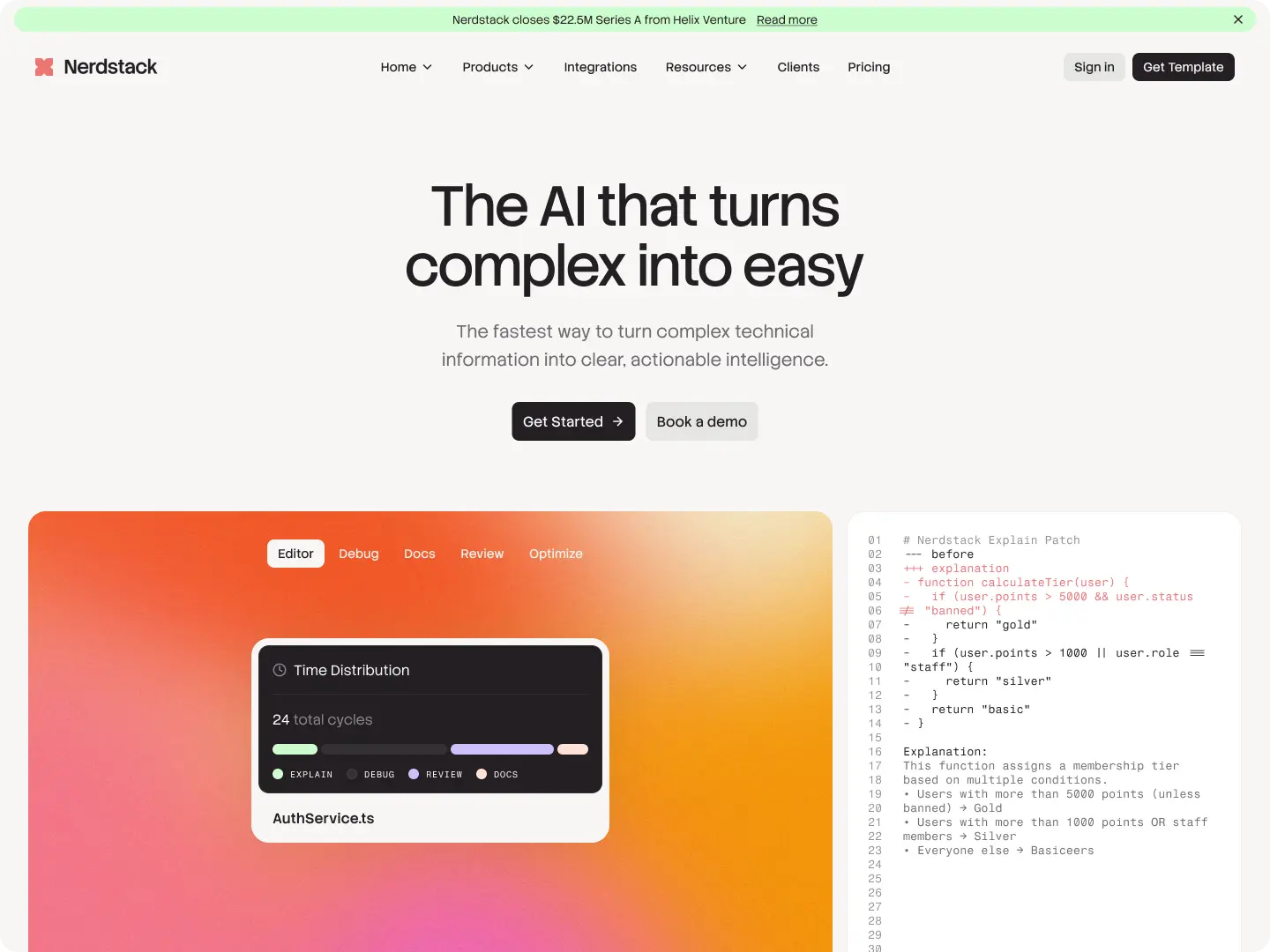
The AI that turns complex into easy

The fastest way to turn complex technical information into clear, actionable intelligence.
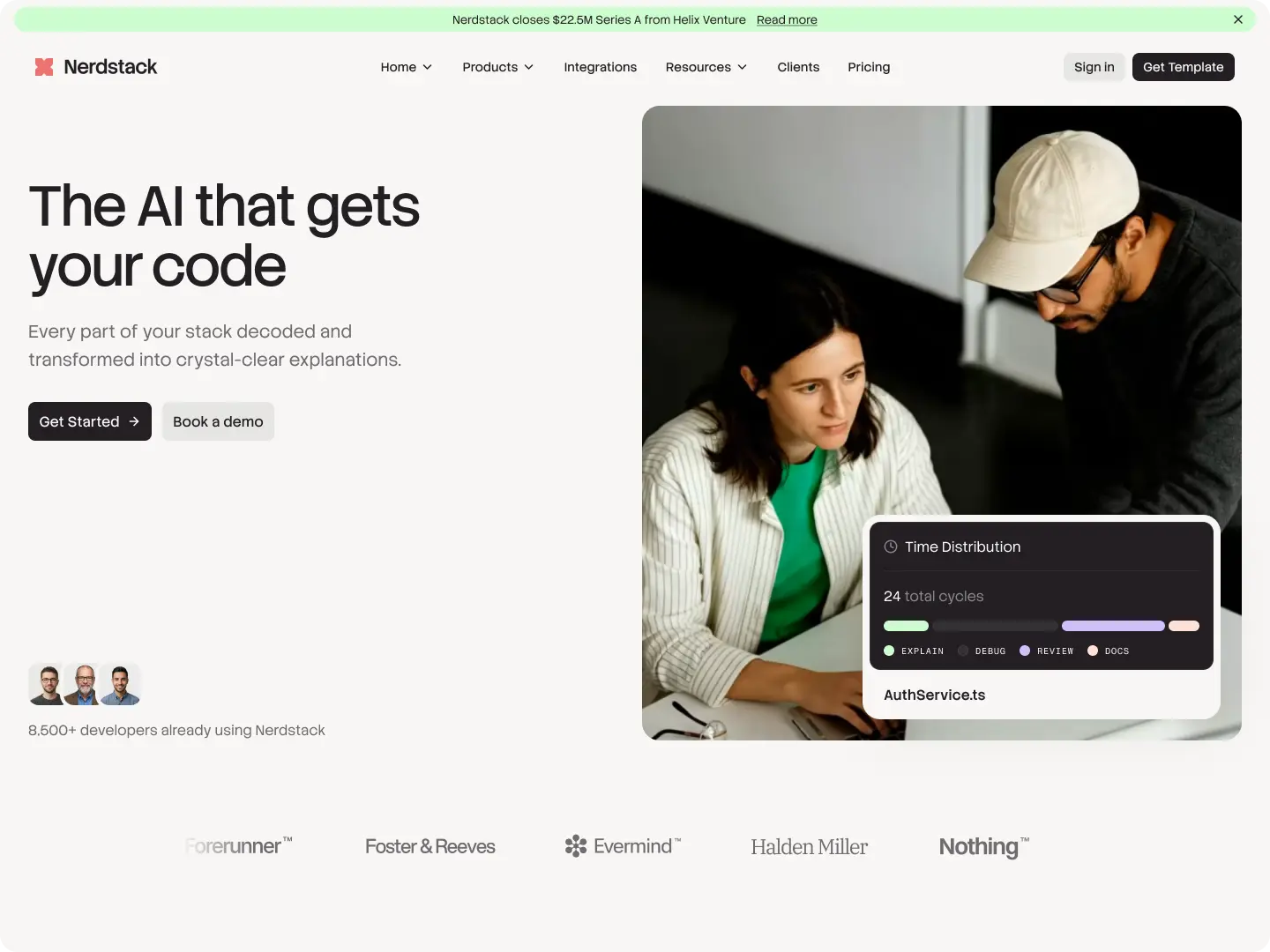
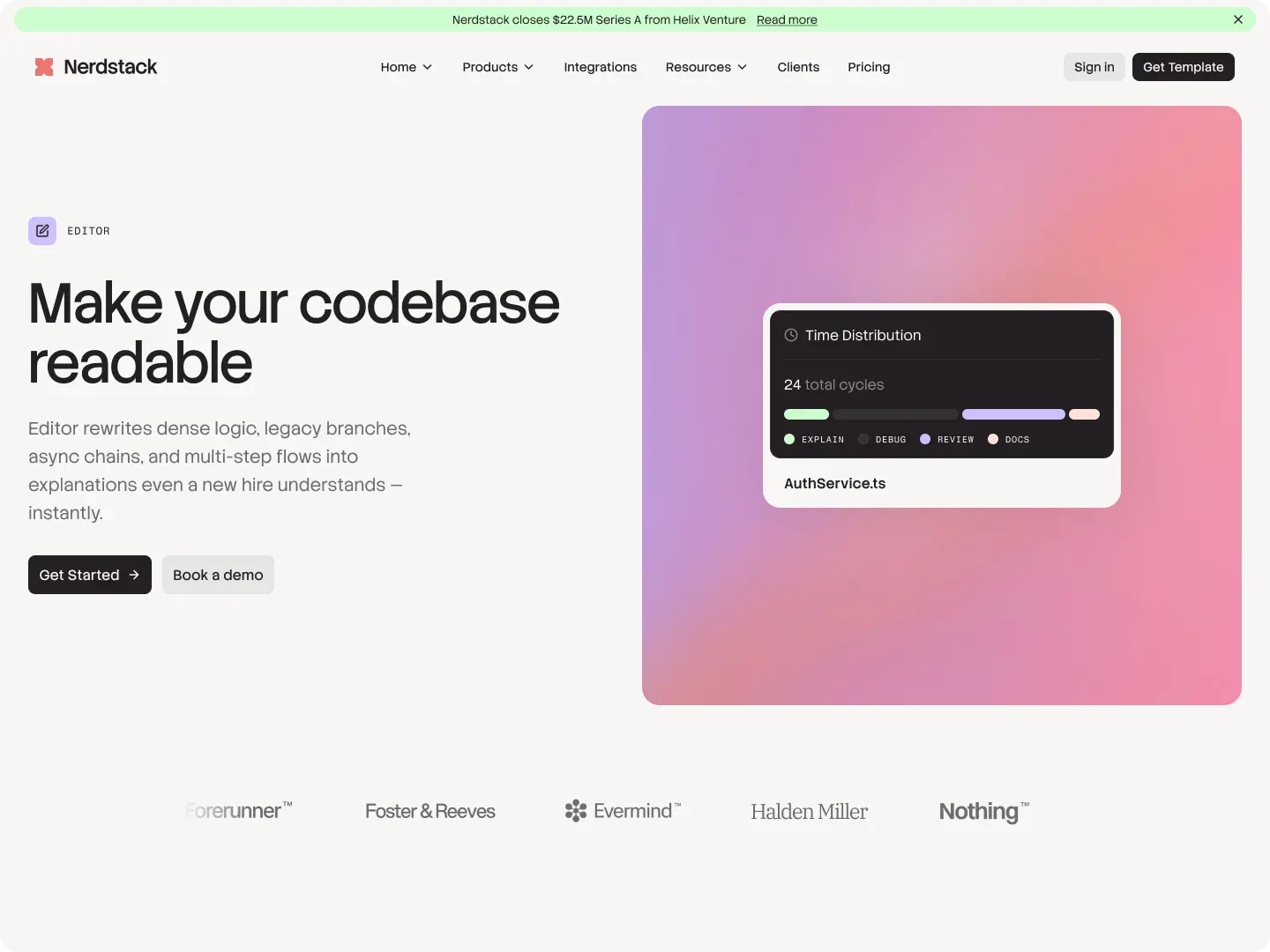
Time Distribution
24 total cycles
Explain
Debug
Review
Docs
AuthService.ts
tab text
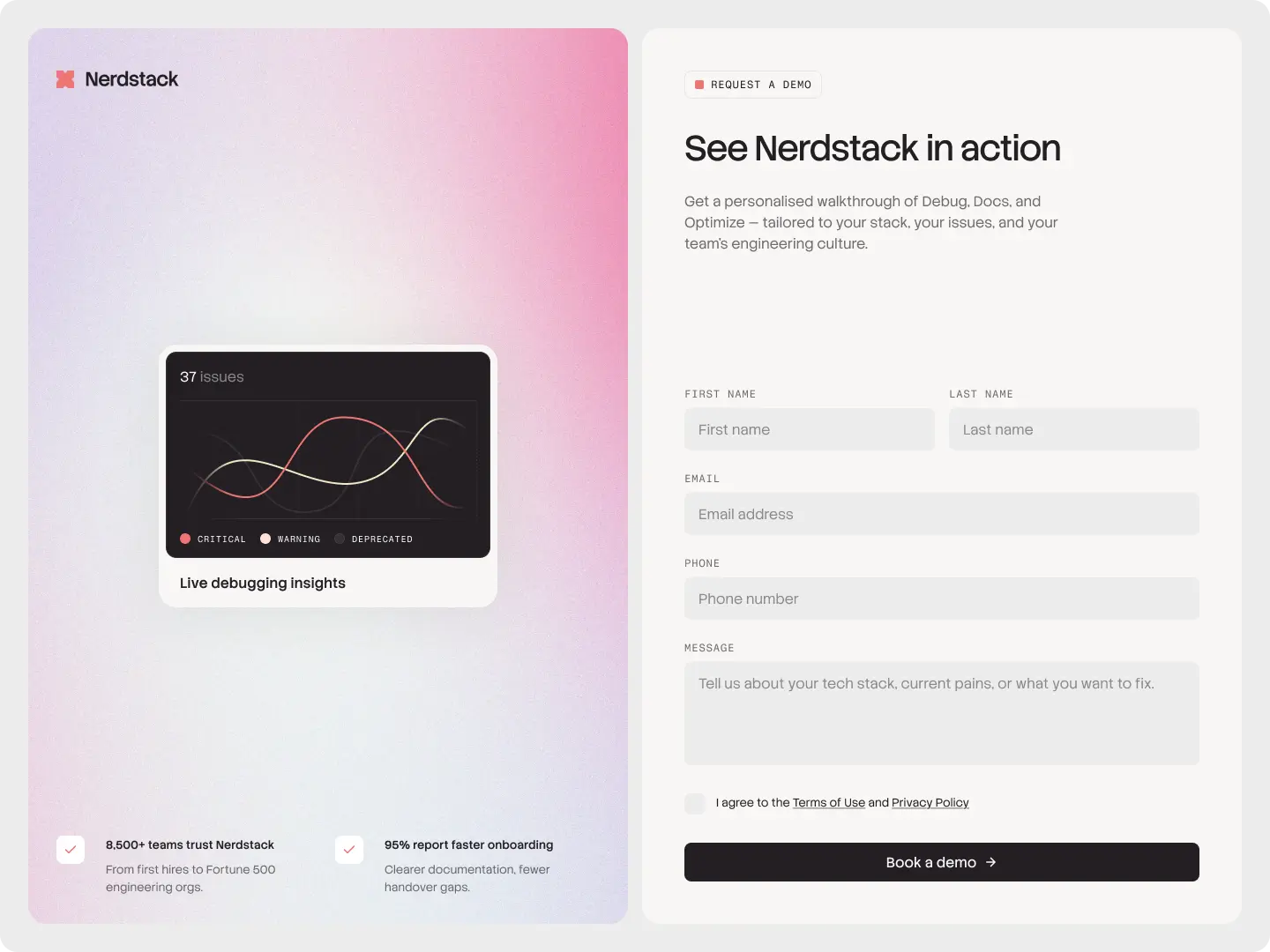
37 issues
Critical
Warning
Deprecated
Error Timeline
code-text-right-1
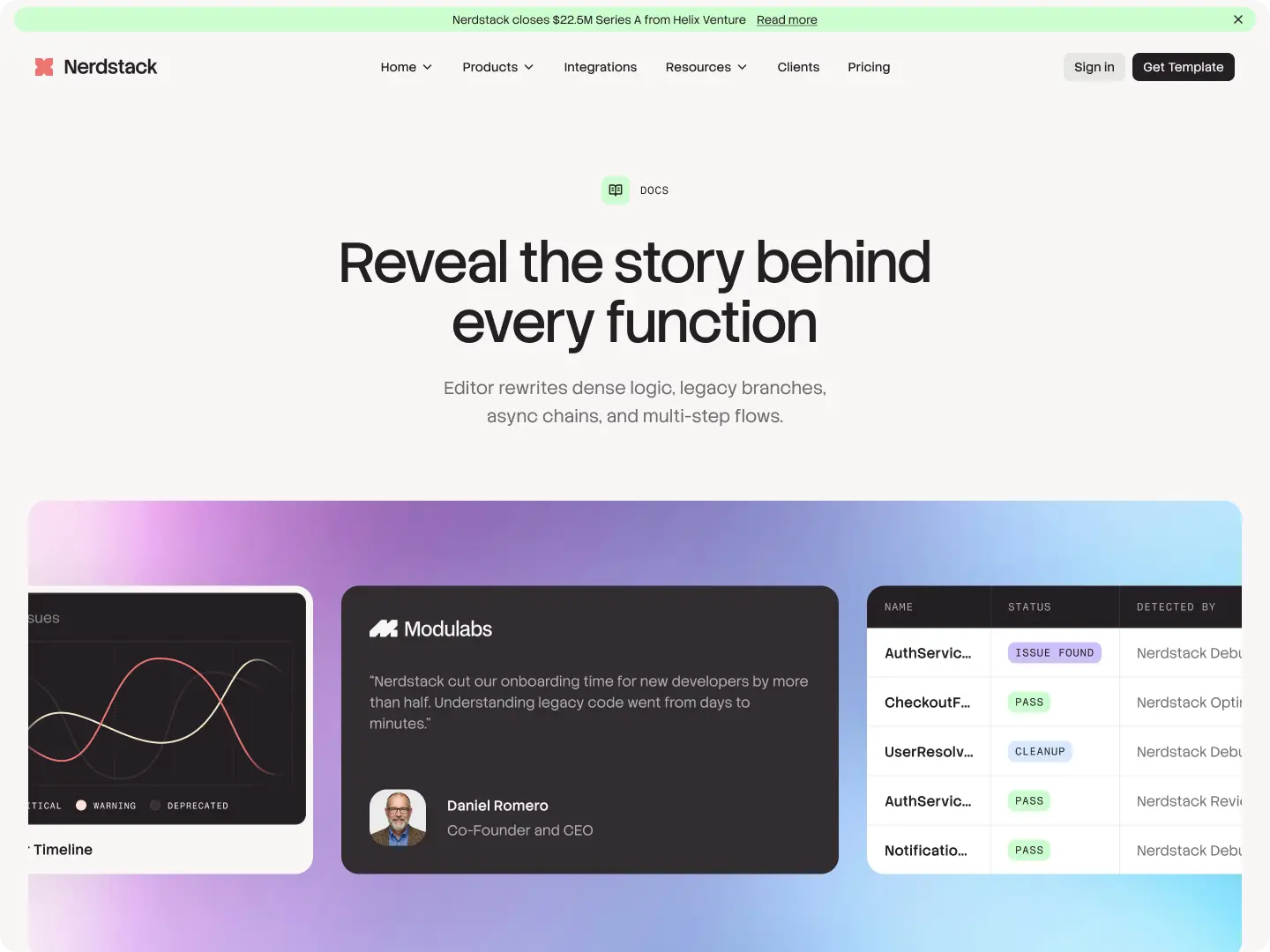
Name
Status
Detected BY
AuthService.ts
ISSUE FOUND
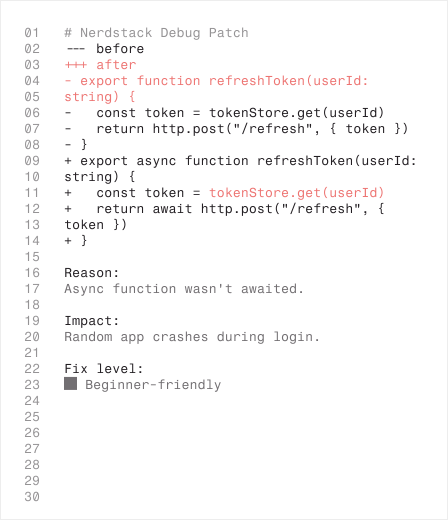
Nerdstack Debug
CheckoutFlow.tsx
Pass
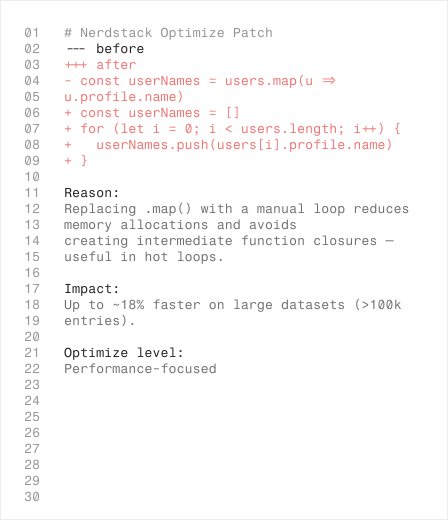
Nerdstack Optimize
UserResolver.js
Cleanup
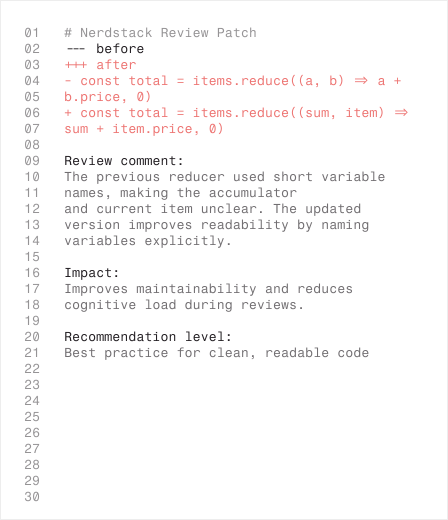
Nerdstack Review
NotificationQueue.go
Pass
Nerdstack Debug
code-text-right-1

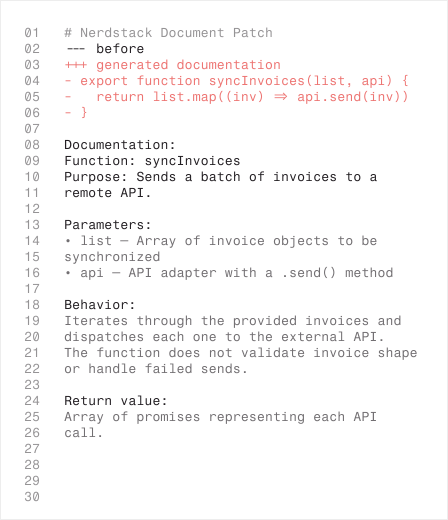
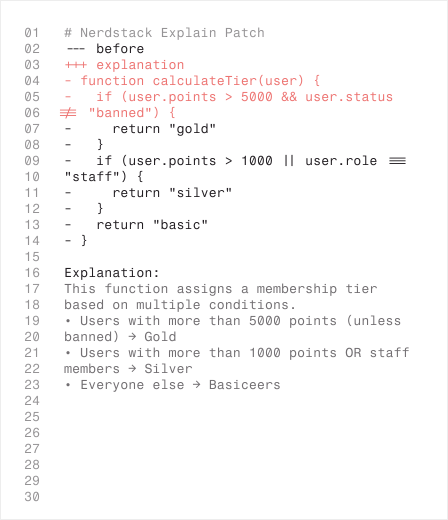
Summarizes authentication logic, token lifecycle rules, and edge cases — in plain engineering language, not autogenerated boilerplate.

Pass
AuthService.ts
Module
code-text-right-1
Async pitfalls
Common mistake: un-awaited promises inside conditionals.
Dead code hints
3 unreachable branches detected in UserResolver.js.
Render cost spikes
CheckoutFlow.tsx re-renders 11× more than necessary.
Suggested insights
code-text-right-1
Debug

See the problem before it becomes a problem

When your codebase grows, blind spots multiply. Debug surfaces hidden issues, unstable patterns, and silent failures — long before they impact your users.

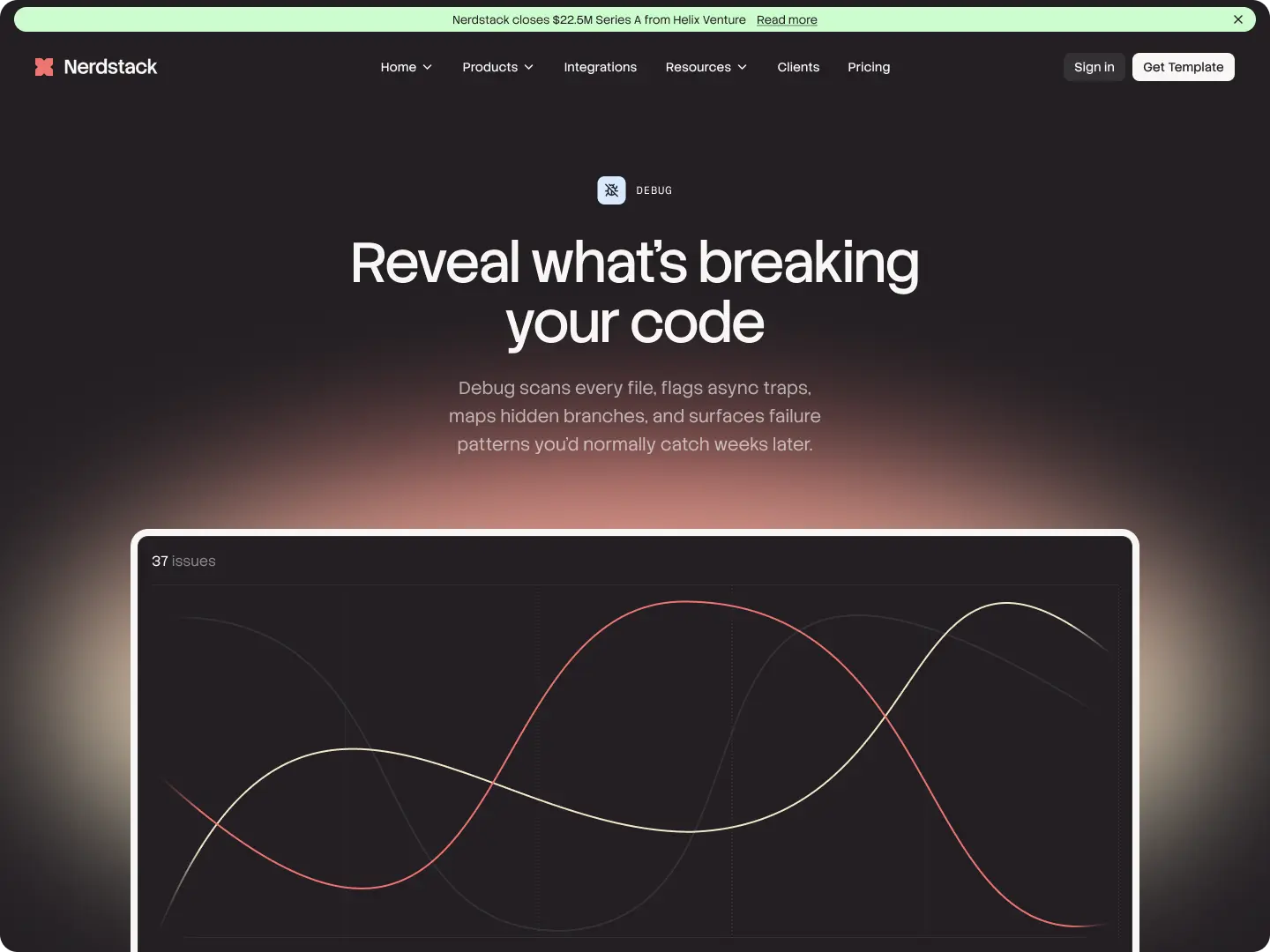
37 issues
Critical
Warning
Deprecated
Error Timeline
Docs

Documentation that writes itself — and actually makes sense

Stop chasing tribal knowledge. Docs converts complex logic, flows, and modules into clean, searchable explanations your whole team can trust.

Name
Status
Detected BY
AuthService.ts
ISSUE FOUND
Nerdstack Debug
CheckoutFlow.tsx
Pass
Nerdstack Optimize
UserResolver.js
Cleanup
Nerdstack Review
NotificationQueue.go
Pass
Nerdstack Debug
optimize

Performance you can feel — clarity you can measure

Optimize reveals render spikes, dead branches, wasted cycles, and slow paths, helping your team ship faster, smoother, and with absolute confidence.

Async pitfalls
Common mistake: un-awaited promises inside conditionals.
Dead code hints
3 unreachable branches detected in UserResolver.js.
Render cost spikes
CheckoutFlow.tsx re-renders 11× more than necessary.
Suggested insights

100% increase in efficiency for analyst productivity

Read case study

Revolutioning information retrieval with a search engine

Read case study
No items found.
No items found.
Products

From cryptic logic to clean insight in seconds

Testimonials

Teams that ship smarter choose Nerdstack

“Our product team finally speaks the same language as engineering. Nerdstack gives us clear, human explanations for even the most complex modules.”

customets image 1
Daniel Romero
Co-Founder and CEO

“Nerdstack cut our onboarding time for new developers by more than half. Understanding legacy code went from days to minutes.”

jacek
Jacek Rosiński
CTO

“We pushed a big refactor through with zero stress. The AI reviews and explanations made our entire workflow cleaner and faster.”

author testimonial
Maya Fischer
Head of Engineering

“Our product team finally speaks the same language as engineering. Nerdstack gives us clear, human explanations for even the most complex modules.”

customets image 1
Daniel Romero
Co-Founder and CEO

“Nerdstack cut our onboarding time for new developers by more than half. Understanding legacy code went from days to minutes.”

jacek
Jacek Rosiński
CTO

“We pushed a big refactor through with zero stress. The AI reviews and explanations made our entire workflow cleaner and faster.”

author testimonial
Maya Fischer
Head of Engineering

“Our product team finally speaks the same language as engineering. Nerdstack gives us clear, human explanations for even the most complex modules.”

customets image 1
Daniel Romero
Co-Founder and CEO

“Nerdstack cut our onboarding time for new developers by more than half. Understanding legacy code went from days to minutes.”

jacek
Jacek Rosiński
CTO

“We pushed a big refactor through with zero stress. The AI reviews and explanations made our entire workflow cleaner and faster.”

author testimonial
Maya Fischer
Head of Engineering

“Debugging used to be the bottleneck. Now Nerdstack flags issues, shows causes, and even suggests patches we can merge instantly.”

alejandro
Alejandro Vargas
Engineering Lead

“Debugging used to be the bottleneck. Now Nerdstack flags issues, shows causes, and even suggests patches we can merge instantly.”

jessica
Jessica Mercedes
Head of Engineering

“Nerdstack cut our onboarding time for new developers by more than half. Understanding legacy code went from days to minutes.”

customets image
Daniel Romero
Co-Founder and CEO

“Debugging used to be the bottleneck. Now Nerdstack flags issues, shows causes, and even suggests patches we can merge instantly.”

alejandro
Alejandro Vargas
Engineering Lead

“Debugging used to be the bottleneck. Now Nerdstack flags issues, shows causes, and even suggests patches we can merge instantly.”

jessica
Jessica Mercedes
Head of Engineering

“Nerdstack cut our onboarding time for new developers by more than half. Understanding legacy code went from days to minutes.”

customets image
Daniel Romero
Co-Founder and CEO

“Debugging used to be the bottleneck. Now Nerdstack flags issues, shows causes, and even suggests patches we can merge instantly.”

alejandro
Alejandro Vargas
Engineering Lead

“Debugging used to be the bottleneck. Now Nerdstack flags issues, shows causes, and even suggests patches we can merge instantly.”

jessica
Jessica Mercedes
Head of Engineering

“Nerdstack cut our onboarding time for new developers by more than half. Understanding legacy code went from days to minutes.”

customets image
Daniel Romero
Co-Founder and CEO

Turn technical chaos into predictable clarity

Time Distribution
24 total cycles
Explain
Debug
Review
Docs

Maps how your code is used across explainers, previews, reviews, and docs.

37 issues
Critical
Warning
Deprecated

Shows how risk evolves across deployments so your team can intervene early.

Async pitfalls
Common mistake: un-awaited promises inside conditionals.
Dead code hints
3 unreachable branches detected in UserResolver.js.
Render cost spikes
CheckoutFlow.tsx re-renders 11× more than necessary.

Highlights hidden patterns your team might miss in day-to-day work.
Questions?

We’re glad you asked.

What software does ScaleLabs actually build—and what kinds of workflows do you automate?

ScaleLabs builds custom, production-grade software that automates internal business processes end to end. That usually means replacing “people-powered” workflows trapped in email threads, spreadsheets, PDFs, and legacy tools with a single system that routes work automatically, enforces rules, and creates visibility.

Common automations we deliver:
Intake + onboarding: customer/vendor onboarding, KYC, compliance packets, document collection, approvals
Operations + dispatch: job routing, scheduling handoffs, QA checks, exception handling
Finance ops: invoice validation, PO matching, collections workflows, vendor payments, reconciliation
Sales + account workflows: quoting, renewals, customer requests, SOW generation, status updates
Data + reporting: consolidating multi-system data into a clean operational dashboard (not another BI graveyard)

Most projects include AI agents for tasks like extraction, classification, summarization, routing, and proactive follow-ups—always with guardrails and audit trails so the system is reliable, not “mysterious.”

How is ScaleLabs different from hiring a dev shop, buying a SaaS tool, or using an RPA platform?

Three big differences:

1) We operate like an in-house technical team, not a “ticket-taking” vendor.

We help you define the workflow, map edge cases, design the system, ship it, and support it. You get senior product + engineering leadership without building an internal org from scratch.

2) We thrive in complex environments.
If your process touches 5–10 systems, involves approvals, exceptions, messy documents, and multiple teams—this is where we’re best. Off-the-shelf tools often fail when reality gets complicated.

3) We deliver automation that sticks.
A lot of automation dies in week 6 because it’s brittle, lacks ownership, or doesn’t match how teams actually work. We build software with: clear roles + permissions, human-in-the-loop checkpoints where needed, monitoring, logs, and measurable SLAs, ierative rollouts so adoption stays high.

Bottom line: you get real operational software, not a prototype, and not a “tool you now have to become an expert in.”

What does a typical engagement look like—from first call to live deployment?

Most successful projects follow a structured path:

Week 1–2: Discovery + workflow mapping
We map your current process, identify failure points, quantify time/cost, and define the “to-be” workflow. You’ll walk away with a clear scope, timeline, and ROI model.

Week 3–6: MVP build + integration foundation
We ship a first working version quickly so stakeholders can react to something real. We also set up core integrations (CRM/ERP/document systems) early so we’re building in the real environment.

Week 7–10: Automation depth + AI agents + edge cases
This is where we add the intelligence: routing, extraction, validations, exception handling, approvals, notifications, and role-based dashboards.

Week 10–12: Pilot + rollout + training
We deploy to a pilot group, measure improvements, then roll out broader with training and feedback loops.

After launch, we typically run 30–60 days of hypercare, then shift to a light ongoing support + optimization cadence.

How long does it take, and when should we expect ROI?

Timelines depend on workflow complexity and integration depth, but here are realistic ranges:

Workflow automation MVP: 4–8 weeks
Deeply integrated, multi-department system: 8–14 weeks
Enterprise-grade rollout across sites/regions: 12–20 weeks

ROI tends to show up fast because we target workflows with recurring labor cost and high friction.

Typical outcomes we design for (varies by industry/process):
30–60% reduction in manual admin time on the targeted workflow
2–10x faster cycle times (onboarding, approvals, document turnaround, etc.)
Lower error rates through validation, automation, and consistent routing
Higher customer satisfaction due to transparency and fewer “what’s the status?” touches

Many clients see payback within 3–6 months when the workflow touches revenue, compliance risk, or high-volume ops.

How do you handle security, compliance, and integrations with our existing systems?

We build for real businesses—security and compliance are not optional.

Security standards we commonly implement: role-based access control (RBAC) and least-privilege permissions, audit logs for key actions and data changes, encryption in transit and at restSSO (SAML/OAuth) where required, secure secrets management and environment separation (dev/stage/prod)

AI safety and governance: we use guardrails (allowed actions, confidence thresholds, approvals), sensitive data handling policies (redaction, retention controls), human-in-the-loop checkpoints for high-risk decisions, transparent prompts/outputs and traceability for critical steps

Integrations:
We regularly integrate with CRMs, ERPs, document systems, and internal databases via APIs and webhooks. If you’re dealing with legacy tools, we’ll design around constraints using reliable integration patterns—without building a fragile house of cards.

If needed, we can align to your organization’s security review process and provide documentation for IT, procurement, and compliance teams.

Ready to automate your operations?